
Ever feel like you’re stuck in neutral? Pouring hours into learning a new skill, only to see everyone else seemingly shooting ahead? It’s a frustrating feeling, especially
when the internet is filled with “get rich quick” schemes and “learn anything in a weekend” promises. We’re bombarded with messages that imply immediate results are the norm, making the slow, steady grind of real learning feel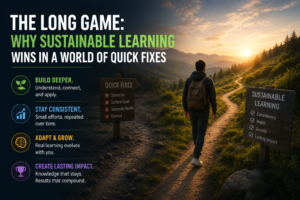 I get it. I’ve been there. Countless times. Starting a new project, reading every article, watching every video, and feeling that initial burst of excitement. Then, the inevitable dip.
The motivation wanes. Progress slows. Doubts creep in. You look at others, seemingly miles ahead, and the feeling of inadequacy hits hard. The cycle repeats itself. And it’s exhausting. The truth is, that initial burst is often just that – a burst. Real growth, the kind that sticks, is a marathon, not a sprint. It’s a long game.
The Illusion of Instant Mastery
We’re living in an age of information overload. Knowledge is readily available. Courses are cheap. Tutorials abound. But access to information isn’t the same as actual skill.
The myth of instant mastery is a powerful one. We see the polished results of others, the finished product, the expert performance, and assume that’s where we should be, too. We forget the years of practice, the countless mistakes, the plateaus, and the sheer grit that got them there.
Consider the musician who plays a flawless concerto. We hear the music, the effortless flow, and the technical brilliance. We might assume they just “have it”.
But what we don’t see are the hours spent in practice rooms, the frustrating scales, the missed social events, and the unwavering dedication. It is rare to see the “making of” in skill development.
This is where most learners give up. They chase the quick wins. They jump from one course to another, hoping to find the magic bullet.
They get discouraged when their progress doesn’t match their expectations. They compare their beginnings to others’ middles (or even their ends!), and feel like they’re somehow failing.
The core issue? We haven’t fully grasped the concept of compounding. We want the instant gratification of a quick win without understanding the power of slow, steady, consistent effort. We undervalue the importance of building a solid foundation, brick by brick. Real development takes time. It’s a process, not a destination.
Understanding the Compounding Effect
Learning, like investing, works on the principle of compounding. Small, consistent efforts, done over time, yield exponential results. Think of it like this:
If you improve by just 1% each day in a skill, where will you be in a year? Not 365% better, but roughly 37 times better! (1.01 ^ 365 = 37.78). This is the magic of compounding.
Growth rarely feels dramatic in the moment. You won’t see a massive leap in skill every day. There will be plateaus, moments of doubt, and times when you feel like you’re going backward. But those small, consistent efforts – the daily practice, the diligent
study, the willingness to learn from your mistakes – are building a powerful foundation. Over time, that foundation will support a level of skill you never thought possible.
Think about a language learner. They might start with basic vocabulary and grammar. Each day, they learn a few new words, practice a sentence structure, or listen to a short conversation. At first, progress seems slow. They struggle to understand native speakers. They make mistakes. They get frustrated.
But they stick with it. They keep showing up. And gradually, things start to click. They begin to understand more and more. They can hold basic conversations.
They read articles and understand the gist. Then, they begin to think in the language. The compounding effect has kicked in. They’ve built a strong foundation, and their skills have blossomed.
This is true for any skill: coding, writing, playing an instrument, public speaking, or even building a high-performing team. The key is to understand that the initial gains will be slow. Embrace the process, trust the compounding effect, and celebrate the small wins along the way.
Building Sustainable Learning Systems
So, how do you play the long game? How do you create a learning system that allows you to thrive, not just survive, in the world of rapid change? It comes down to establishing sustainable habits and building a process that works for you, not against you.
Here are some of the key elements:
- Define your “why.” What drives you? What are you trying to achieve? A clear purpose provides the fuel to keep going, especially when things get tough.
- Set realistic goals. Break down your larger goals into smaller, manageable steps. This makes the process less daunting and allows you to celebrate your progress along the way.
- Focus on consistency, not intensity. Showing up consistently is far more important than cramming. A little bit every day is better than a lot once a week. This allows the compounding effect to take place.
- Embrace the process. Enjoy the journey. Learning should be challenging, but it should also be engaging and fulfilling. Find ways to make it fun.
- Track your progress. Keeping a record of your learning helps you see how far you’ve come. It also helps you identify areas where you may need to adjust your approach.
- Seek feedback. Ask for feedback from others. It is one of the fastest routes to improvement.
- Be patient. Real change takes time. Don’t get discouraged by slow progress. Trust the process and keep going.
Building these systems is not always easy. It’s a continuous process of self-assessment, experimentation, and refinement. But with persistence, you can develop habits that will sustain your learning journey for years to come.
Common Mistakes to Avoid
In the quest for continuous improvement, there are common pitfalls that can derail your progress. Avoiding these mistakes is crucial for playing the long game successfully.
- Chasing shiny objects. Constantly jumping from one course, book, or technique to another, without giving anything a chance to work, is a recipe for stagnation.
- Ignoring the fundamentals. Building a strong foundation is essential for long-term growth. Neglecting the basics in favor of advanced techniques is a recipe for shaky progress.
- Failing to practice consistently. Learning is not a spectator sport. It requires active participation and consistent practice.
- Comparing yourself to others. Everyone learns at their own pace. Comparing your progress to others is a surefire way to kill your motivation.
- Giving up too soon. Most worthwhile endeavors take time and effort. Don’t quit when the going gets tough.
- Avoiding feedback. The fear of criticism can be paralyzing. But feedback is essential for improvement. Seek it out and use it to learn and grow.
These mistakes can be challenging to avoid, but with awareness and discipline, you can steer clear of the traps that will slow your progress and hinder your development. Remember: Slow and steady wins the race.
The Long-Term Impact: Beyond Skills
The benefits of sustainable learning extend far beyond the acquisition of specific skills. It shapes your mindset, opens doors to opportunities, and fundamentally changes the way you approach life.
- A Growth Mindset: Sustained learning fosters a growth mindset – the belief that your abilities can be developed through dedication and hard work. This mindset empowers you to embrace challenges, learn from failures, and see effort as the path to mastery.
- Adaptability and Resilience: The ability to learn new things quickly and effectively is a valuable asset in the modern world. Sustainable learning builds your adaptability and resilience, equipping you to navigate change and thrive in an uncertain future.
- Expanded Opportunities: As you acquire new skills, you open up new opportunities. You can pursue different career paths, take on new projects, and connect with people from different backgrounds.
- Increased Confidence: As you see yourself consistently improving and overcoming challenges, your confidence grows. This confidence spills over into other areas of your life, empowering you to take risks and pursue your goals.
- A Deeper Sense of Purpose: Learning is a journey of self-discovery. As you explore new areas of knowledge and develop new skills, you gain a deeper understanding of yourself and your place in the world.
The impact of long-term learning isn’t just about the skills you acquire; it is about the person you become. It’s about developing the habits and mindset that enable you to thrive in any environment. It’s about living a life of continuous growth and fulfillment.
The Future of Learning and the Adaptable Mind
In the years ahead, the ability to learn and adapt will be more critical than ever. The pace of technological change is accelerating, and the skills needed to succeed in the job market are constantly evolving. The Growfunda platform knows that those who embrace lifelong learning will be best positioned to thrive. Adaptability is the ultimate skill.
Here’s what that looks like:
- Continuous Skill Refinement: The best professionals will be constantly updating their skills.
- Hybrid Learning: Expect a mix of online courses, virtual workshops, and in-person experiences.
- Personalized Learning Paths: Tailored learning experiences based on individual needs and goals will become the norm.
- Focus on Soft Skills: Communication, critical thinking, creativity, and emotional intelligence will be even more valued.
- Community and Collaboration: Learning will become more collaborative and community-driven.
To navigate this landscape successfully, focus on developing a growth mindset, embracing new technologies, and actively seeking out opportunities for continuous learning. Adaptability is no longer a luxury, but a necessity. The future belongs to the lifelong learner.
FAQ: Your Questions Answered
Here are some frequently asked questions, answered with the wisdom of experience:
- How do I stay motivated when progress is slow?Focus on celebrating the small wins. Break down your goals into smaller steps, and acknowledge your progress along the way. Remember your “why” and connect with others who share your goals.
- How do I overcome the feeling of being overwhelmed?Start small. Focus on one area at a time. Create a realistic schedule, and don’t be afraid to take breaks. Seek support from others and remember that Rome wasn’t built in a day.
- What if I don’t see results immediately?That’s normal! Trust the process. Consistency is key. Keep practicing, keep learning, and trust that the compounding effect will eventually kick in.
- How can I stay focused on learning amidst a busy schedule?Integrate learning into your daily routine. Even 15-30 minutes a day can make a difference. Prioritize your learning and treat it as a non-negotiable part of your schedule.
- Is it okay to change my learning path?Absolutely! Your goals and interests may change over time. Embrace the freedom to adjust your learning path as needed. Don’t be afraid to pivot and explore new areas.
- How do I deal with the fear of failure?View failures as opportunities for learning. Embrace mistakes as part of the process. Celebrate your effort and resilience, rather than fixating on outcomes.
- What are the most important skills for the future?Adaptability, critical thinking, problem-solving, and communication skills will be essential. Also, the ability to learn new things and embrace change will be paramount.
- How do I know when I’ve “mastered” a skill?Mastery is a journey, not a destination. You’ll know you’re on the right track when you can consistently perform the skill, solve complex problems, and adapt to new situations. You may never feel you have mastered a skill, but the journey of improvement is a worthwhile pursuit in itself.
The long game is not always easy, but it is ultimately the most rewarding. It’s about developing the habits, mindset, and skills that will serve you not just today, but for a lifetime. It is a journey. Embrace the process, trust the compounding effect, and keep learning. The rewards will be well worth the effort.